
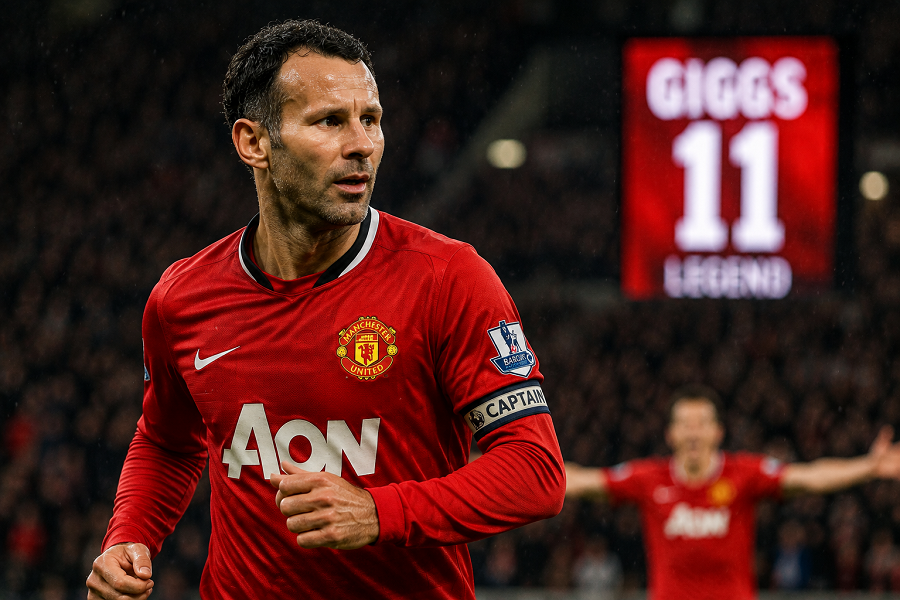
Few names carry as much weight in Welsh football history as Ryan Giggs. Born in Cardiff, the winger went on to become one of the most decorated players in English football history during a remarkable twenty-three-year career at Manchester United. His journey from a schoolboy prospect to club legend and eventually national team manager makes him one of the defining figures in the story of Welsh football, both at club level and on the international stage.
From Cardiff to Manchester
Ryan Joseph Giggs was born in Cardiff on 29 November 1973. His father, Danny Wilson, was a rugby international who played both rugby union and rugby league for Wales. Giggs moved to Manchester with his family at the age of six after his father signed for Swinton RLFC. He began his footballing education with Manchester City’s youth setup before joining Manchester United on his fourteenth birthday in 1987, a signing that would go on to define both his career and the club’s history for more than two decades.
A One-Club Man for Twenty-Three Years
Giggs made his professional debut for Manchester United in 1991 and remained a first-team player for the next twenty-three years, an extraordinary run of longevity rarely matched in the modern game. Over the course of his career he made 963 appearances for the club, a record for competitive appearances that still stands, and scored 168 goals. Predominantly a left winger renowned for his pace, close control and consistency, Giggs was a member of United’s famous “Class of ’92” generation, which also produced David Beckham, Paul Scholes, Gary Neville and Nicky Butt.
One of the Most Decorated Footballers of All Time
Giggs’ trophy cabinet places him among the most successful footballers in the history of the English game. During his time at Old Trafford he won thirteen Premier League titles, more than any other player in history, alongside four FA Cups, three League Cups, two UEFA Champions League titles, a FIFA Club World Cup, an Intercontinental Cup, a UEFA Super Cup and nine FA Community Shields. He is one of only twenty-eight players worldwide to have made over 1,000 career appearances, a testament to both his ability and his remarkable physical durability across such a long career.
Wales Caps and Olympic Captaincy
At international level, Giggs earned 64 caps for Wales between 1991 and 2007 and captained his country during that time. His international career was not without criticism, however, as pundits and supporters occasionally questioned his availability for friendly fixtures throughout his playing days. In 2012, Giggs was named captain of the Great Britain football team that competed at the London Olympics, a fitting honour given his stature within British football more broadly.
An Early Taste of Management at Old Trafford
Giggs’ first experience of first-team management came at the end of the 2013-14 season, when he was appointed Manchester United’s interim player-manager following the sacking of David Moyes. Over four games in charge, Giggs guided the Red Devils to two wins, a draw and a defeat. Following this spell, he was named assistant manager under Moyes’ permanent successor, Louis van Gaal, and retired from playing on the same day this appointment was announced, bringing an end to his playing career after 963 competitive appearances.
Appointed Wales Manager in 2018
After leaving his coaching role at Manchester United in 2016, Giggs was appointed manager of the Wales national team in January 2018 on a four-year contract, succeeding Chris Coleman, who had guided Wales to the semi-finals of Euro 2016. Giggs beat out competition from Craig Bellamy, Mark Bowen and Coleman’s former assistant Osian Roberts for the role. His reign began in memorable fashion, with Wales beating China 6-0 in his first match in charge, a game that saw Gareth Bale score a record-breaking hat-trick.
Stepping Back and the Rise of Robert Page
Giggs stepped away from his managerial duties with Wales in November 2020, with assistant coach Robert Page taking over first on an interim basis. Under Page’s stewardship, Wales reached the round of sixteen at the delayed Euro 2020 tournament and then secured qualification for the 2022 World Cup in Qatar, the country’s first World Cup appearance since 1958, with a play-off victory over Ukraine. Giggs formally resigned from the Wales manager position in June 2022, stating that he did not want speculation around his role to affect the team’s preparations for the tournament, and Page was subsequently confirmed as permanent manager on a four-year contract.
Setting the Record Straight
Giggs’ departure from the Wales role coincided with a legal case brought against him following his arrest in November 2020. After an initial trial in August 2022 ended with a jury unable to reach a verdict, prosecutors ultimately withdrew the case in July 2023, and a judge formally entered not guilty verdicts on all charges. Giggs’ legal team stated at the time that he had always maintained his innocence throughout the two-and-a-half-year legal process and intended to move forward with his career and life following the case’s conclusion.
A Legacy Woven Into Welsh Football
Whatever direction his career takes next, Giggs’ place in the history of Welsh Premier League football and the wider story of the Welsh game remains secure. His playing achievements at Manchester United rank among the greatest of his generation anywhere in British football, and his 64 caps and captaincy of the national side cemented his status as one of the players Welsh football fans point to with genuine pride, regardless of the club level at which they themselves follow the game.
Why His Story Still Resonates
Giggs’ career offers a genuinely rare case study in sustained excellence: a single-club career spanning twenty-three years, a trophy haul that few players anywhere in the world can match, and a subsequent role leading his country onto the international stage. For supporters of Welsh football at every level, from the top flight down to the passionate community clubs that make up the domestic game, his career remains a reference point for what talent, dedication and longevity can achieve within the sport.
Conclusion
From a fourteen-year-old signing at Manchester United to the most decorated player in Premier League history and later manager of his national team, Ryan Giggs’ career traces one of the most remarkable arcs in British football. His achievements at club level remain almost unmatched, and his contribution to Welsh football, both as a player and later in the dugout, ensures his name will remain part of the conversation around the country’s footballing history for a long time to come.